Cleveland QLD 4163 

Top 10 Types of Home Solar Systems for Global Buyers
Choosing among home solar systems is no longer a simple question of installing panels on a roof. Global buyers now compare rooftop photovoltaic arrays, battery-backed hybrids, off-grid kits, balcony systems, solar carports, and portable units. Each design responds to different sunlight levels, electricity prices, roof structures, and reliability needs.
Fatih Birol, Executive Director of the International Energy Agency, stated, “Solar is becoming the new king of electricity markets.” His observation reflects a changing energy landscape, but it does not remove the need for careful planning. A coastal home may require corrosion-resistant equipment. A rural property may need larger batteries and a backup generator. An urban apartment might only have a balcony and limited mounting space. Small details matter.
This guide examines ten practical types of home solar systems for buyers in different regions. It considers system size, storage, installation complexity, maintenance, and likely household use. It also explains where each option may perform well, and where it may disappoint. That matters.
Real-world experience often exposes gaps in product brochures. A battery can lose usable capacity in extreme temperatures. A low-cost inverter may create expensive replacement problems later. Local installers, grid rules, roof conditions, and seasonal weather should influence every decision. No single system fits everyone. Some recommendations may still require revision as prices and technologies change. Readers should verify technical specifications with qualified professionals before purchasing.
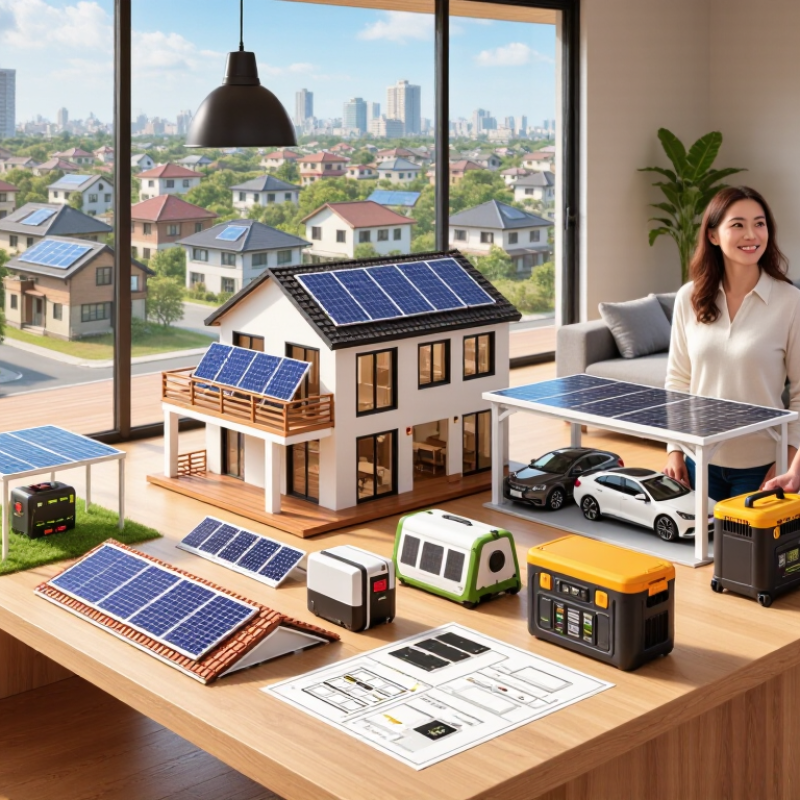
How Residential Solar Systems Are Classified for Global Buyers
Top 10 Types of Home Solar Systems for Global Buyers
How Residential Solar Systems Are Classified for Global Buyers
Residential solar systems are classified by grid connection, battery use, installation style, and household purpose. The main types include grid-tied, hybrid, and off-grid systems. Other categories cover rooftop, ground-mounted, balcony, portable, community, and building-integrated systems. These labels describe system behavior, not just panel placement.
Grid-tied systems send surplus electricity to the utility network. They usually cost less because batteries are optional. Hybrid systems add batteries for evening use and limited backup power. Off-grid systems require larger batteries, careful load planning, and often a backup generator. The system must match local sunlight, tariffs, climate, and grid reliability. A sunny roof is not enough.
IRENA reported that global solar capacity increased by about 345 gigawatts in 2023. This rapid expansion supports wider residential adoption, but national markets remain very different. The IEA Photovoltaic Power Systems Programme also highlights falling system costs and growing distributed solar deployment. Buyers should check inverter standards, roof structure, battery safety, maintenance access, and installer qualifications. NREL’s residential PV cost benchmarks show that hardware is only part of the final price. Permits, labor, wiring, and design can change the result. These categories can overlap. A rooftop hybrid system may also operate as a backup system. Classification is useful, but real homes rarely fit one perfect box.
Top 10 Types of Home Solar Systems for Global Buyers - How Residential Solar Systems Are Classified for Global Buyers
A practical comparison of common residential solar configurations by grid connection, storage architecture, backup capability, and typical application.
| Rank | Residential System Type | Grid Connection | Battery Storage | Power Conversion Architecture | Backup During Outages | Typical Global Use Case | Main Advantages | Main Limitations |
|---|---|---|---|---|---|---|---|---|
| 1 | Grid-Tied Solar Without Battery | Connected to the utility grid | None | PV array with a grid-interactive inverter | Normally no; the inverter shuts down when the grid fails | Urban and suburban homes with reliable electricity and net-metering or export rules | Lowest upfront complexity; reduces daytime electricity purchases; high conversion efficiency | No solar power during a grid outage; savings depend on local export tariffs |
| 2 | Grid-Tied Solar with Battery Backup | Connected to the utility grid | Yes; commonly lithium-ion or other approved rechargeable batteries | Hybrid inverter or separate PV and battery inverters | Yes, for selected backed-up circuits or the whole home if properly sized | Homes facing outages, time-of-use rates, or low solar-export compensation | Energy shifting, outage resilience, and reduced evening grid consumption | Higher cost; usable backup duration depends on battery capacity and household loads |
| 3 | Hybrid Solar System | Grid-connected, with islanding capability when permitted | Usually yes | A hybrid inverter manages PV, battery, household loads, and the grid | Yes, subject to inverter rating, battery state of charge, and local regulations | Markets combining grid supply with frequent outages or variable electricity prices | Integrated control; flexible self-consumption; can combine backup and grid charging | More complex design and commissioning; export and backup functions vary by jurisdiction |
| 4 | Off-Grid Solar Home System | Not connected to the utility grid | Essential; sized for overnight and low-sun periods | Charge controller and battery inverter, often with a backup generator | Yes, when sufficient stored energy is available | Remote homes, islands, rural properties, and locations without practical grid access | Energy independence; avoids grid-extension costs; adaptable to remote locations | Requires careful load management, larger storage, and planning for cloudy periods |
| 5 | AC-Coupled Solar-plus-Storage System | Usually connected to the utility grid | Yes | PV inverter and battery inverter connect on the home AC bus | Yes, if the battery inverter includes approved backup operation | Adding storage to an existing solar installation, especially during a retrofit | Often easier to retrofit; can work with an existing PV inverter | Additional conversion steps can reduce round-trip efficiency compared with some DC designs |
| 6 | DC-Coupled Solar-plus-Storage System | Usually connected to the utility grid | Yes | PV and battery share a DC bus before conversion to household AC | Yes, with a suitable hybrid inverter and protected-load panel | New installations where solar charging and battery integration are planned together | Can reduce conversion steps; may capture excess PV efficiently through direct battery charging | Less convenient for some retrofits; inverter and battery compatibility must be checked |
| 7 | String-Inverter Solar System | Grid-tied or hybrid | Optional | Multiple PV modules are connected in series strings to one central inverter | Only when paired with approved backup equipment | Unshaded roofs with simple orientations and relatively uniform module conditions | Generally economical; straightforward servicing; fewer power electronics on the roof | Shading or uneven roof orientations can reduce output from affected strings |
| 8 | Microinverter Solar System | Grid-tied or grid-tied with storage | Optional; commonly added through compatible AC or integrated storage equipment | A small inverter is installed at or near each PV module | Normally no without a separate approved energy-storage and backup system | Roofs with multiple orientations, partial shading, or a need for module-level monitoring | Independent module operation; flexible array design; detailed monitoring | More rooftop electronics; replacement access can be more labor-intensive |
| 9 | Solar System with Backup Generator | Grid-connected, off-grid, or weak-grid | Optional; may be smaller when the generator provides extended backup | Solar inverter combined with an automatic or manually controlled generator system | Yes, when fuel and generator capacity are available | Areas with long outages, seasonal low sunlight, or critical household loads | Longer-duration resilience; useful during extended cloudy periods | Fuel, noise, emissions, maintenance, and additional installation requirements |
| 10 | Solar Home System with Load Management | Grid-connected or off-grid | Optional, but beneficial for shifting energy | PV inverter with smart controls, metering, and controllable household loads | Depends on storage and the designated backup circuits | Homes using electric water heating, heat pumps, electric vehicles, or other flexible loads | Improves self-consumption by matching solar production with household demand | Requires compatible controls, accurate metering, and changes to usage schedules |
Related Posts
-
How to Choose a Home Solar System with Battery Storage in 2026?
-
Top 10 Best Solar Systems for Your Home in 2026?
-
Best Solar Power Systems for Efficient Energy Solutions?
-
How to Choose the Best Home Solar System for Your Energy Needs in 2023
-
Exploring the Benefits of Solar Power for Global Buyers?
-
How to Choose the Best Solar Power System for Your Home and Save Money